Table of Contents
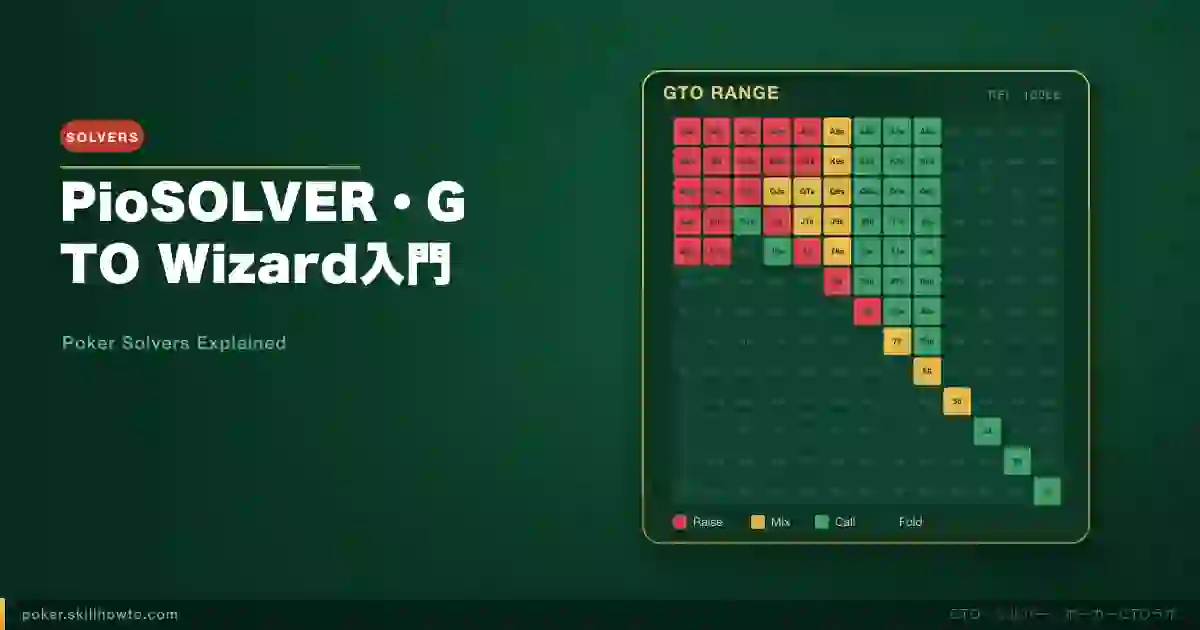
You can’t study GTO seriously without a solver. This guide explains what solvers compute, how PioSOLVER and GTO Wizard differ, and a beginner workflow that won’t burn you out.
What a solver actually computes
A poker solver is software that iteratively approximates a near–Nash-equilibrium strategy for a given spot (both ranges, stacks, and board). Its output is a set of frequencies (a mixed strategy) — e.g., “bet 70%, check 30%” — plus the EV of each action.
Under the hood it runs CFR (Counterfactual Regret Minimization), updating the strategy to minimize “regret” until it converges. You don’t need the math, but you must remember one thing: a solver’s answer is not absolute — it depends entirely on the ranges you input.
PioSOLVER vs GTO Wizard
- •Desktop app
- •Solve any spot
- •Intermediate+
- •In the browser
- •Browse pre-solved
- •Beginner-friendly
| PioSOLVER | GTO Wizard | |
|---|---|---|
| Form | Desktop app you install | Cloud app in the browser |
| Compute | Solves on your PC (fully flexible) | Browse pre-solved solutions |
| Level | Intermediate to advanced | Beginner-friendly |
| Strength | Configure any custom spot | Drills and stats built in |
Beginners should start with a pre-solved tool like GTO Wizard. You skip building game trees and can instantly check the “answer” for standard spots. Move to PioSOLVER once you want to dig into custom situations.
A 3-step beginner solver workflow
- Read the policy, not the percentages — at first, grab only the big tendency (“c-bet this board at high frequency”). Ignore the 0.3% mixes.
- Target your own leaks — only review hands you were genuinely unsure about. Trying to cover everything guarantees burnout.
- Verbalize the “why” — don’t memorize outputs; be able to say “I attack because this board favors my nutted range.”
A solver is not a tool to memorize answers — it’s a tool to find where your intuition is wrong.
A common misconception
- •Near-optimal play given the input ranges
- •Correct EV estimates for each action
- •A baseline to measure your own deviations against
- •Insight into balanced, unexploitable tendencies
- •Accurate answers if input ranges are wrong
- •Automatic profit vs. real opponents
- •Accounting for opponent tendencies or exploits
- •Replacing reads, game-flow, and table dynamics
“Play like the solver and you’ll always win” is false. A solver is only correct if the ranges you input are correct. Feed it unrealistic ranges and you get unrealistic answers. And since real opponents don’t play GTO, exploitation ultimately matters most.
Summary
Solvers are the standard study tool in modern poker, but misuse wastes hours. Loop through “grab the policy → target leaks → verbalize the why” to improve as fast as possible.
Related reading
This article was prepared by the Poker GTO Lab editorial team for educational purposes, drawing on widely published solver outputs, training content, and preflop charts. The ranges and frequencies shown are representative tendencies; the true optimum depends on stack depth, opponents, and table rules. This site does not promote gambling.