Table of Contents
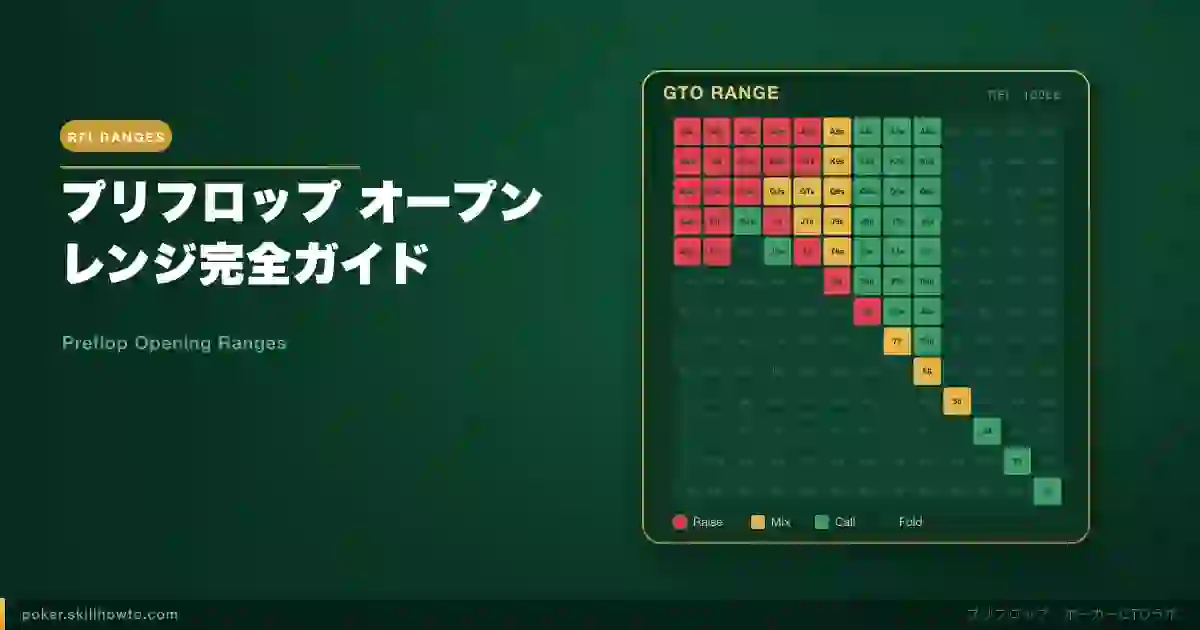
Preflop is the most frequent — and most error-prone — moment in poker. Just learning correct opening ranges (RFI = Raise First In) puts you ahead of most players. This guide organizes opening standards by position for 6-max.
Principle: open wider the later you are
The fewer players left to act behind you, the wider you can open, because positional advantage and the value of stealing the blinds both rise.
| Position | Approx. open % | Range character |
|---|---|---|
| UTG (first) | ~15–18% | Strong pairs, broadways, AQ+ |
| MP | ~18–21% | UTG + suited connectors, small pairs |
| CO | ~26–30% | Most suited, down to KJo |
| BTN | ~42–50% | Very wide — all suited, many offsuit |
| SB | ~35–44% | Raise-or-fold (or a limp blend) |
Concrete opening standards (examples)
- •Pairs 22+
- •AJo+, KQo
- •Strong suited
- •Pairs 22+
- •Nearly all suited
- •Wide offsuit too
UTG (under the gun)
- Pairs: 22+ (small pairs for set-mining)
- Suited: A2s+, KTs+, QTs+, JTs, T9s, 98s
- Offsuit: AJo+, KQo
BTN (button)
- Pairs: 22+
- Suited: almost everything (A2s+, K2s+, Q4s+, J6s+, 54s+)
- Offsuit: wide (A2o+, K8o+, Q9o+, J9o+)
Don’t memorize individual hands — learn the structure: as position improves, the range widens from suited toward offsuit holdings.
What open size should you use?
In modern 6-max, 2.0–2.5bb is standard. In ante tournaments 2.0–2.2bb is common; in cash, around 2.5bb. From the button you can open smaller (2.0–2.2bb) to see flops cheaply while inviting blind defense.
Common mistakes
- •Open KTo / Q9s from UTG (too loose)
- •Call with A7o from early position
- •Limp frequently from SB
- •UTG range: AJo+, KQo, strong suiteds only
- •Fold A7o / marginal Ax-Kx offsuit early
- •Default raise-or-fold from SB; limp selectively
- Opening too wide early — KTo or Q9s from UTG is too loose.
- Overvaluing offsuit Ax/Kx — A7o is a fold from early position.
- Limping too much from the SB — default to raise-or-fold; limp only selectively.
Summary
RFI ranges are the multiplier base of poker strategy. Lock them in and your 3-bet responses and postflop decisions become consistent too. Start by memorizing your main position (CO/BTN for most players), then expand.
Related reading
This article was prepared by the Poker GTO Lab editorial team for educational purposes, drawing on widely published solver outputs, training content, and preflop charts. The ranges and frequencies shown are representative tendencies; the true optimum depends on stack depth, opponents, and table rules. This site does not promote gambling.