Table of Contents
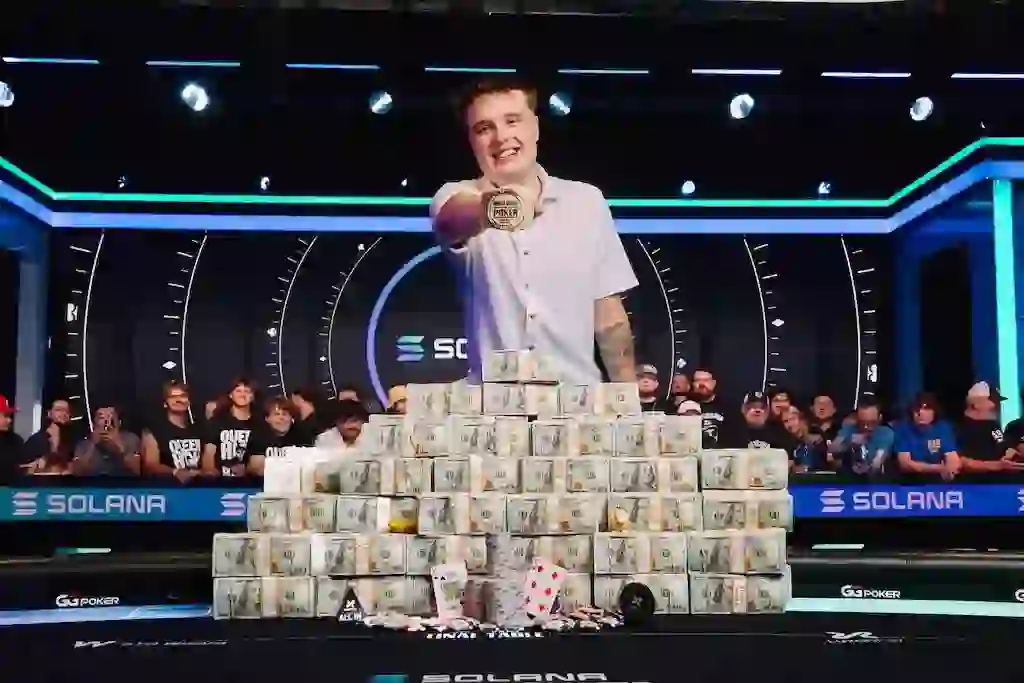
In the 2026 WSOP Main Event, one hand captured the imagination of the poker world and decided the $10 million title. Lauri Saaskilahti, the Finnish veteran, chose to call a massive overbet from young American Lucas Jumalon — holding only a pair of jacks against a nut flush. The "J-3 hero call" ignited fierce debate and ultimately handed Jumalon the championship.
1. The Hand That Shook the Table
- •Hand: Q♠ 5♠ — Nut Flush
- •Board: 4♣ A♠ K♠ J♠ 6♠
- •Bet: 180M overbet into 100M pot
- •Result: Won the pot, clinched the title
- •Hand: J♠ 3♠ — Pair of Jacks
- •No flush draw, minimal equity
- •Called 180M against the nut flush
- •Result: Lost the hand and the championship
The showdown unfolded on a board of 4♣ A♠ K♠ J♠ 6♠. Jumalon held Q♠ 5♠ for the nut flush, while Saaskilahti held J♠ 3♠ for a pair of jacks. Jumalon opened with a 180 million overbet into a pot of 100 million — a calculated move designed to maximise value or induce a hero call. After a tense pause, Saaskilahti made the dramatic call, a decision that would cost him the tournament and an additional $4 million in prize money.
2. Saaskilahti's Decision: A Calculated Risk or a Misstep?
- •Jumalon could be bluffing or overvaluing
- •Deep stack allows high-risk moves
- •Final-table psychological pressure
- •Range read: Jumalon bets wide here?
- •Board texture heavily favors flush
- •J♠ 3♠ has near-zero equity vs flush
- •Pot odds strongly favor folding
- •Runner-up $6M guaranteed either way
From a purely statistical standpoint, Saaskilahti's hand was a significant underdog with minimal equity against Jumalon's made flush. The call required a belief that Jumalon was bluffing or overvaluing. Many analysts argue that given the board texture and pot odds, folding was the correct play. Others point to the psychological pressure of a final table and the desire to stay competitive as factors that could rationalise the risk. The debate continues in the poker community.
3. Jumalon's Dominance and the Final Table Dynamics
Jumalon's performance throughout the final table was commanding. He entered with a decisive chip lead and maintained control throughout. His aggressive yet calculated style kept opponents constantly on the back foot. After the J-3 hand, he continued to press, eventually moving all-in from the button with K♠ 6♠ against Saaskilahti's A♠ 7♠. The flop came J♠ 8♠ 6♠, giving Jumalon trips, and the turn 6♣ sealed the victory. See the full story at our Lucas Jumalon champion profile.
4. The Aftermath: Saaskilahti's Reflection and the Legacy of the Hand
Saaskilahti, despite the heartbreak of a $4 million pay-jump he just missed, remained philosophical.
"I cannot be too disappointed, you know, second place, six million… (It is) maybe not life-changing money, but it's I mean, financially my long-term goal is to build generational wealth." — Lauri Saaskilahti — (see original)
The runner-up finish earned him $6 million and cemented his status as one of the tournament's most resilient players. The J-3 call will be remembered as a defining moment illustrating the razor-thin margin between boldness and overcommitment at the highest level.
5. Final Table Results and What It Means for the Future
| Place | Player | Payout | POY Points | PGT Points |
|---|---|---|---|---|
| 1 | Lucas Jumalon | $10,000,000 | 3,300 | 1,550 |
| 2 | Lauri Saaskilahti | $6,000,000 | 2,750 | 1,350 |
| 3 | Greg Mueller | $3,750,000 | 2,200 | 1,200 |
| 4 | Michael Gagliano | $2,750,000 | 1,650 | 1,175 |
| 5 | Han Feng | $2,250,000 | 1,375 | 1,150 |
| 6 | Rami Hammoud | $1,750,000 | 1,100 | 1,125 |
| 7 | Jamie Shaevel | $1,500,000 | 825 | 1,125 |
| 8 | Mario Boos | $1,250,000 | 550 | 1,100 |
| 9 | Evagoras Evagorou | $1,000,000 | 275 | 1,100 |
Jumalon's wire-to-wire win at 22 years, 4 months, and 28 days makes him the second-youngest champion in WSOP history. Saaskilahti's hero call will serve as a cautionary tale — and a fascinating case study — about the fine line between bold aggression and overcommitment in high-stakes poker.
Summary
The J-3 hero call will be debated for years: was it a gutsy bluff-catch attempt or a costly final-table error? What is beyond debate is that Jumalon's nut flush held, the $10M pot was his, and the 2026 WSOP Main Event title was decided by a single river decision on a five-spade board.