Table of Contents
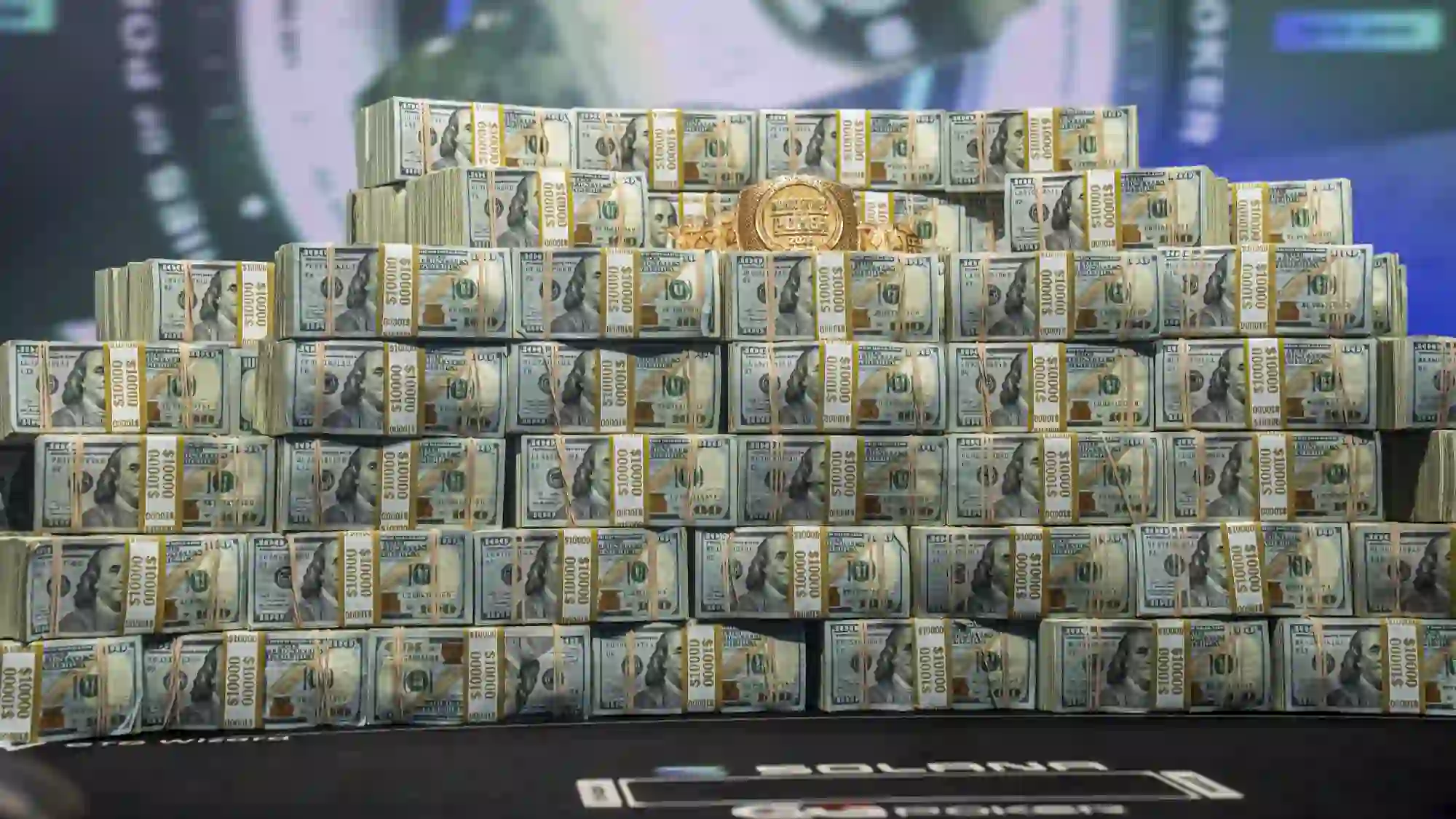
When the 2026 WSOP Main Event ended, headlines celebrated a $10 million first-place prize. The reality: the champion and his eight fellow finalists surrendered more than 40% of the combined $30.25 million prize pool to tax authorities around the world. Here is the full after-tax breakdown — and what it means for anyone serious about a poker career.
The Tax Toll on the Champion
Lucas Jumalon, 22, from Spokane, Washington, won the title and a $10 million check. Washington has no state income tax, so his obligations were limited to federal income tax and self-employment tax — a combined bill of $3,990,826. His effective rate of 39.91% is among the highest ever recorded for a WSOP champion, yet it is lower than what he would have paid in California or New Jersey.
- •Federal income tax
- •Self-employment tax
European Players Face Heavy Burdens
Two European finalists illustrate how residency can dramatically cut post-tax pay. Finland's Lauri Saaskilahti (2nd, $6M) is exempt from U.S. tax under treaty, but his Barcelona residency triggered Spanish taxes at 47%, costing him $2,773,000. France's Mario Boos (8th, $1.25M) paid 43.5% to the French tax office under France's progressive rates for high earners. Both players retained a smaller share of their prize than any of the North American finalists.
- •Spain 47% (Saaskilahti)
- •France 43.5% (Boos)
- •Canada 30% (Mueller, Hammoud)
- •USA avg ~44.6% (NJ/TX/CA/WA)
Canadian Advantage and U.S. State Variations
Canada's Greg Mueller (3rd, $3.75M) and Rami Hammoud (6th, $1.75M) benefited from a flat 30% withholding under Canadian law. Because neither was classified as a professional by the CRA, no additional federal tax applied — their nets were $2,628,000 and $1,228,000. Among U.S. players, state tax made the decisive difference. Jamie Shaevel (CA) faced the steepest combined rate at 50.37%, while Han Feng (TX) paid just 39.54% with no state income tax. Michael Gagliano's New Jersey residency pushed his rate to 48.39%, partly due to the new OBBBA law limiting loss deductions.
The Collective Tax Takeaway
Across all nine finalists, governments collected $12,273,963 — exactly 40.58% of the $30,250,000 prize pool. The table below shows each player's pre-tax prize, after-tax net, and effective rate.
| Position | Player | Country | Winnings | After Tax | Tax % |
|---|---|---|---|---|---|
| 1 | Lucas Jumalon | USA (WA) | $10,000,000 | $6,009,174 | 39.91% |
| 2 | Lauri Saaskilahti | Finland | $6,000,000 | $3,227,000 | 47.00% |
| 3 | Greg Mueller | Canada | $3,750,000 | $2,628,000 | 30.00% |
| 4 | Michael Gagliano | USA (NJ) | $2,750,000 | $1,419,317 | 48.39% |
| 5 | Han Feng | USA (TX) | $2,250,000 | $1,360,247 | 39.54% |
| 6 | Rami Hammoud | Canada | $1,750,000 | $1,228,000 | 30.00% |
| 7 | Jamie Shaevel | USA (CA) | $1,500,000 | $744,500 | 50.37% |
| 8 | Mario Boos | France | $1,250,000 | $706,299 | 43.50% |
| 9 | Evagoras Evagorou | Cyprus | $1,000,000 | $653,500 | 35.00% |
What Every Poker Pro Should Know
The 2026 breakdown is a reminder that tax strategy is as important as hand selection. Residency is the single largest variable — a Canadian player keeps 70 cents per dollar, while a Californian keeps fewer than 50. The OBBBA's restrictions on loss deductions add another layer of complexity for U.S. players. Consulting a CPA familiar with tournament income, documenting every buy-in and travel expense, and understanding your home country's treaty status are now baseline requirements at the highest level. For a broader look at how the WSOP has evolved, see our piece on Chris Moneymaker and the new WSOP sponsorship model.
Summary
The 2026 WSOP Main Event paid out $30.25M in prizes, but only $17.97M actually reached the players after taxes. Residency, state law, and legislation like OBBBA determine who keeps the most. A thoughtful tax strategy — starting with where you live — can mean the difference of millions over a career.