Table of Contents
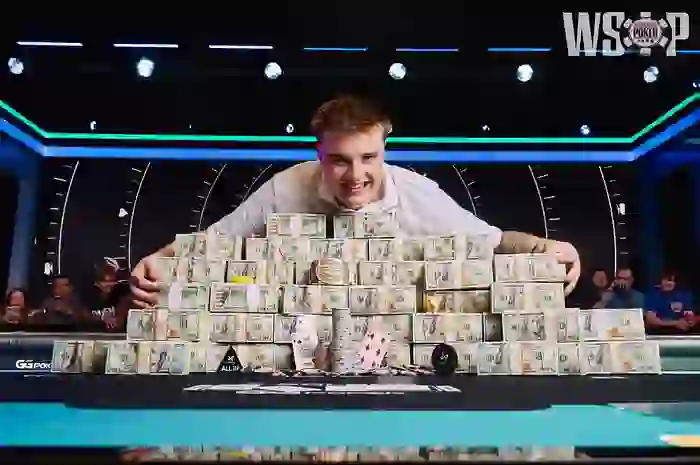
Wire-to-wire victories are the rarest form of tournament poker dominance — leading from the very first table through the final hand without ever relinquishing the chip lead. Lucas Jumalon, a 22-year-old from Spokane, Washington, did exactly that at the 2026 World Series of Poker Main Event, outlasting a field of 9,208 players to claim a $10 million first-place prize and a championship bracelet. His performance established him as the second-youngest WSOP Main Event champion ever and the first from Washington state.
Overview: A Historic Wire-to-Wire Win
When the final hand of the 2026 Main Event concluded, Jumalon had created a story that will echo through poker history for decades. He entered with the standard $10,000 buy-in and walked away with $10 million — a 1,000x return. His run was not defined by one fortunate river card but by consistent aggression and precise timing across days of play. The defining moment came when the final board read 4♣ A♠ K♠ J♠ 6♠ and Jumalon held Q♠, sealing the flush and the championship.
From the Field to the Final Table
The 2026 Main Event opened on July 2 with 9,208 players, each paying $10,000 to compete. By the time the final table was set, eight players remained, including seasoned professionals such as Michael Gagliano, Greg Mueller, and Han Feng. The most intriguing match-up emerged between Jumalon and Finland's Lauri Saaskilahti — both relatively inexperienced at this stage, both having previously posted career highs in the five-figure range. Their encounters on Day 5 hinted at the fierce battle that would unfold at the final table, with Saaskilahti ultimately finishing runner-up for a $6 million payout.
Wire-to-Wire Chip Lead Dominance
- •Pre-flop raise to set tone immediately
- •Large continuation bets to deny equity
- •Half-pot turn bets to maintain control
- •Never relinquished chip lead at final table
- •Middle pair continuation bets
- •All-in with A-T on button
- •Hero call with Jc3c on final hand
- •Finished 2nd for $6M payout
From the first hand of the final table, Jumalon established his pattern: preflop raise, large continuation bet, half-pot turn bet. Pot after pot went his way. This approach was not reckless aggression but calibrated pressure — betting enough to charge opponents without over-committing. Even when Saaskilahti made a bold all-in with A-T on the button, Jumalon, holding A-9, called and forced a showdown. The subsequent river card, a diamond, gave Saaskilahti a marginal hand that fell short, allowing Jumalon to maintain his advantage.
"It's a pure feeling of euphoria," he told PokerNews. "(I feel like) I'm going to wake up tomorrow and be like are we playing again today? I kind of take that mentality with everything. I love this game so much and it's given me so much and given me so many great people. I just can't be more thankful." - Lucas Jumalon - (see original)
Key Hands and Tactical Decisions
Throughout the final table, both players displayed a willingness to play aggressively, but Jumalon's timing and hand selection were consistently superior. When Saaskilahti flopped middle pair and continued betting, Jumalon called with a higher pair, extending his lead. A pivotal moment came when Saaskilahti, after a strong preflop raise, chose to call on the turn — a decision many analysts later questioned as it left him vulnerable to a higher hand.
"I made a hero call, it didn't go my way this time," Saaskilahti said about the pivotal hand. - Lauri Saaskilahti - (see original)
The final hand saw Jumalon bet 180,000,000 chips against Saaskilahti's 8-big-blind stack, forcing an all-or-nothing decision. Saaskilahti called with J♣3♣ and could not overcome Jumalon's Q♠ flush. The hand was decided not by luck but by months of accumulated pressure and disciplined aggression.
Family Pride and What Is Next
Beyond the chips and the bracelet, the victory carried deep personal meaning. Jumalon's mother Robin spoke with palpable pride about the dedication her son brought to every hand of the tournament.
"I'm incredibly proud of him," Robin Jumalon told PokerNews. "It was a lot of hard work to get here. And he's represented himself and his city and his friends so phenomenally. I couldn't be more proud." - Robin Jumalon - (see original)
Jumalon himself acknowledged the need to process the magnitude of the $10 million windfall. While the immediate future remains open, the win has positioned him among the elite names in poker, alongside legends such as Phil Hellmuth and Johnny Chan. His performance at the 2026 Main Event will be studied as a masterclass in tournament strategy and composure under pressure.
Summary: Why This Victory Matters
Lucas Jumalon's 2026 WSOP Main Event win is more than a headline. It is proof that consistent aggression, precise hand-reading, and mental composure can carry a player wire-to-wire through 9,208 opponents. From a $10,000 buy-in to a $10 million payout, his run sets a standard that aspiring players can study, emulate, and learn from. Age is no barrier to greatness — and this championship proves it.