Table of Contents
“Position is everything” is a poker cliché for good reason: the same hand changes value dramatically based on where you sit. This guide lays out the 6-max positions, their roles, and why acting last is such an edge.
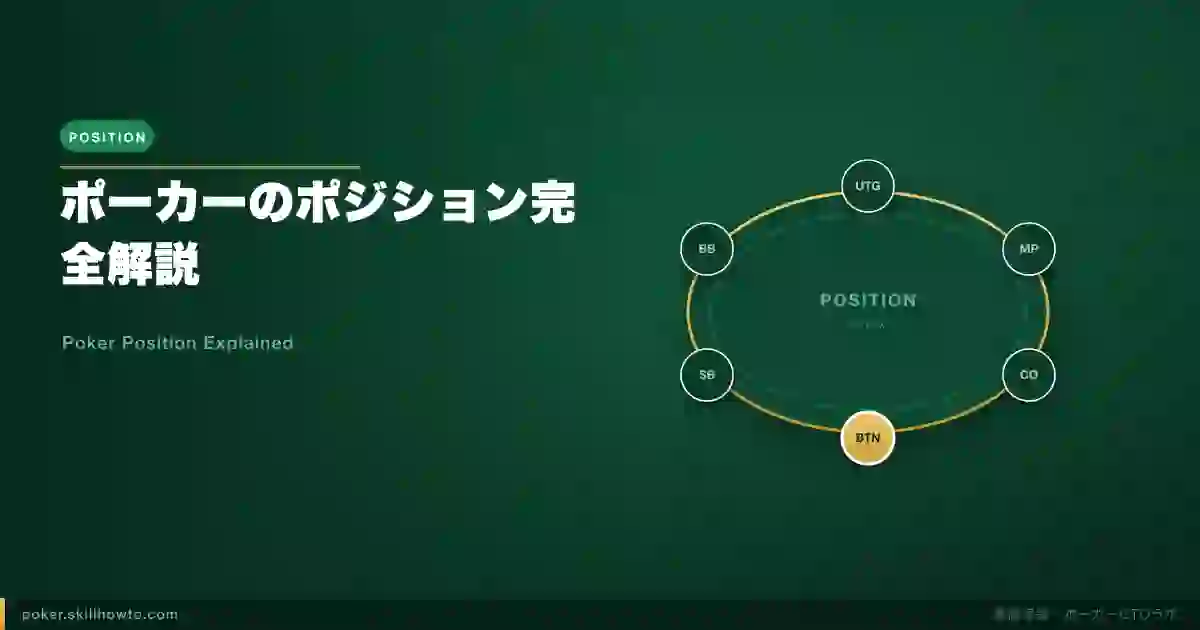
The 6-max positions
| Abbr. | Name | Character |
|---|---|---|
| UTG | Under the gun | Acts first; play tightest. |
| MP / HJ | Middle / Hijack | Open a bit wider. |
| CO | Cutoff | Strong steal seat. |
| BTN | Button | Always last postflop; the best seat. |
| SB | Small blind | Forced bet; out of position postflop. |
| BB | Big blind | 1bb already invested; defends wide. |
Why being “in position” wins
- •Acts last
- •Information edge
- •Efficient bluffs
- •Acts first
- •Easier to read
- •Play tighter
Acting after your opponent postflop gives three edges:
- Information — you decide after seeing their action.
- Pot control — you can check behind to keep the pot small.
- Bluff efficiency — you attack only when they show weakness.
The same AJ is “a bit dicey” from UTG but “comfortable” on the button. That’s the power of position.
Why the blinds (SB/BB) are hard
- •Forced bet: ½ bb
- •Out of position postflop (acts first)
- •Hardest seat to defend
- •Loses the most long-term
- •Forced bet: 1 bb
- •Also out of position postflop
- •1 bb already in → defends wide
- •Better pot odds than SB
The SB and BB have posted forced bets, so they’re “already invested,” but they’re usually out of position postflop. The SB in particular is the toughest seat and tends to lose the most long term. The BB has 1bb in already, so it defends wide based on pot odds.
What beginners should do first
- Tighten up in early position.
- Open and steal aggressively on the button.
- Downgrade out-of-position hands by one notch.
Summary
Position decides when you get information and affects every decision from preflop to river. Playing good position beats waiting for good hands. Burn in one habit first: wide on the button, narrow up front.
Related reading
This article was prepared by the Poker GTO Lab editorial team for educational purposes, drawing on widely published solver outputs, training content, and preflop charts. The ranges and frequencies shown are representative tendencies; the true optimum depends on stack depth, opponents, and table rules. This site does not promote gambling.