Table of Contents
The Hand at a Glance
During Day 4 of the WSOP $1,500 Millionaire Maker, 13 players remained from an 11,769-entry field. Halford Fairchild opened from the cutoff with Q♠10♠; Garry Gurevich called from the big blind with 2♠2♠. The flop A♣K♦J♠ left both players without a clear showdown advantage. Gurevich bet the turn and fired the river as a bluff, but Fairchild's decisive river raise to 10.1 million forced the fold — a textbook lesson in range reading and bet-sizing discipline under tournament pressure.
Pre-Flop Dynamics
- •Q♠10♠ — standard CO hand
- •Suited broadways favored
- •Wide offsuit high-card range
- •2♠2♠ — GTO outlier
- •Solver prefers suited connectors
- •High-card hands more common
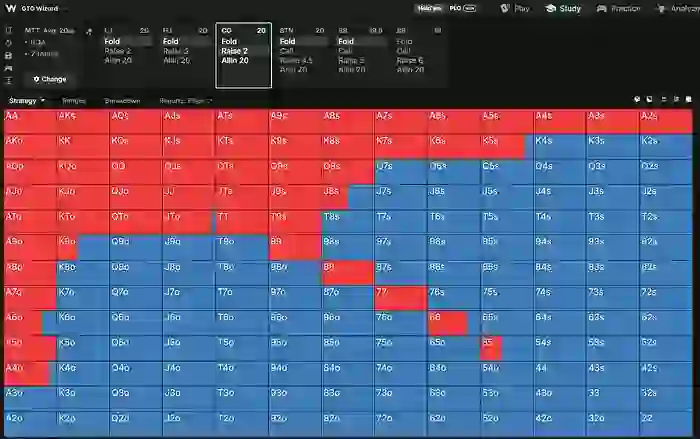
Fairchild's cutoff open with Q♠10♠ sits squarely within a standard solver-approved range: high-card combinations with strong blockers and post-flop playability. Gurevich's call with 2♠2♠ from the big blind is a marginal GTO choice. Solvers generally favor suited connectors and high-card hands in the BB defense range; low pocket pairs are rare at this stack depth and opponent range. The pre-flop mismatch already tilted the post-flop advantage toward Fairchild.
Flop: A♣K♦J♠ Analysis
- •Weak top-pair draw
- •Solver: check to trap
- •No need to build pot now
- •No board connection
- •Check preserves equity
- •Board heavily favors CO
The A♣K♦J♠ flop is one of the most cutoff-favored boards imaginable. Fairchild's Q♠10♠ picks up a gutshot straight draw (any 9 makes the straight), while Gurevich's 2♠2♠ is completely unconnected. The solver recommends both players check: Fairchild preserves his trapping ability; Gurevich avoids building a pot he is unlikely to win. Both players check, and action moves to the turn.
Turn: Gurevich's Bluff with Deuces
The 7♠ on the turn adds a backdoor flush draw for Gurevich but changes little structurally. The solver does not recommend bluffing with pocket deuces here — it prefers flush draws or hands that retain equity when called. Gurevich bets 1.1 million anyway, a calculated deviation: the pot is small, the board is dry, and Fairchild's calling range likely contains many weak top pairs and underpairs that struggle under pressure. Fairchild calls, keeping pot control while representing continued strength.
River: Fairchild's Raise Breaks the Bluff
The 3♠ on the river completes the spade flush draw — and gives Fairchild a straight with Q♠10♠. Gurevich fires again for 3.1 million, continuing the bluff. Fairchild raises to 10.1 million, a size that forces Gurevich to call with unfavorable pot odds. The solver recommends an all-in shove of 16.9 million in this exact spot, but the EV difference versus 10.1 million is minimal. Gurevich correctly folds, reading the raise as a strong value bet from a hand like Q♠10♠.
Lessons for Your Game
- Read ranges, not just hands — Pocket deuces work as bluffs on dry boards where the opponent's range is narrow. Understanding range composition drives every decision.
- Use GTO as a compass — Even when deviating from solver recommendations, the underlying logic of GTO — balancing value with bluffs — should guide your thinking.
- Calibrate your bet sizing — Fairchild's 10.1M raise was slightly below solver-optimal, yet it achieved the same result. Meaningful pressure at the right moment matters more than precision.
- Never dismiss low pairs — In the right context, low pairs win pots as bluffs or bluff-catchers. Recognize when conditions align and act decisively.
For a related hand featuring the same players in the WSOP Main Event, see Fairchild Dethrones Pocket Twos in WSOP Main Event.
Summary
This Millionaire Maker hand demonstrates that beating pocket deuces is not a single trick — it is the result of range analysis, calculated pressure, and decisive sizing when the moment arrives. Fairchild's patient check-call through the flop and turn, followed by a firm river raise, is a masterclass in post-flop discipline. Study hands like this to sharpen your ability to read boards and extract maximum value at critical moments.