Table of Contents
In high-stakes poker, a single hand can crown a champion and become the stuff of legend. The Triton Golden Decade final was exactly that: a massive cooler—a hand where both players made near-optimal decisions yet one player wins an enormous pot—decided in a deep-stack heads-up match that tested ante structure, bet-sizing, and positional instincts at every street.
Pre-hand Context
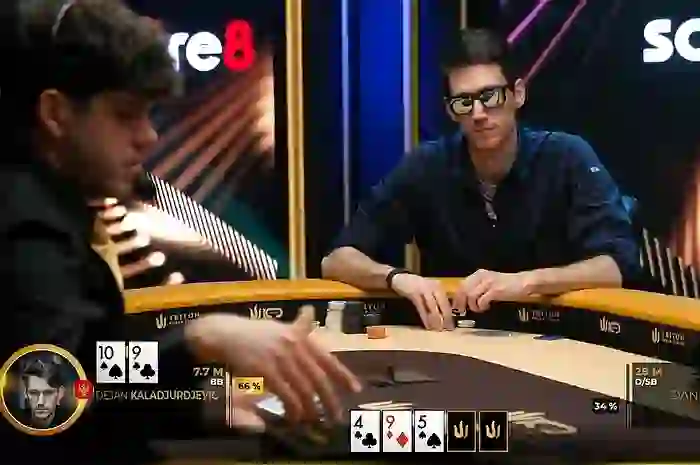
Daniel Dvoress sat in the small blind with 28.6 million chips (~95 big blinds). Dejan Kaladjurdjevic held 7.8 million chips (~26 big blinds) in the big blind. Blinds were 150,000/300,000 with a 300,000 big-blind ante—a full 1BB ante that would prove decisive in shaping every preflop decision that followed.
Preflop Strategy and Ante Impact
- •SB never folds heads-up
- •BB raises ~37% of range
- •Large dead money boosts pot
- •SB folds weakest hands
- •Less aggressive BB play
- •Smaller preflop pots
Dvoress opened by calling with 3-2 offsuit—a line the GTO solver rates as optimal. A full big-blind ante loads the pot with dead money, making it unprofitable for the small blind to fold in heads-up play. Under a 1BB ante structure, GTO calls for the SB to continue with virtually any two cards because the pot odds justify it. With a 0.25BB ante, by contrast, the SB can profitably fold the weakest hands since the pot is smaller.
Kaladjurdjevic checked his T-9 offsuit—also GTO-approved. With a 1BB ante, the solver shows the big blind should raise approximately 37% of the time, mixing in all-in raises to exploit the elevated value of preflop equity. The ante pushed both players toward wider, more aggressive ranges, setting the stage for the cooler to follow.
Postflop Play and the Cooler Moment
The flop fell 9-5-4, giving Dvoress a straight draw and Kaladjurdjevic top pair. Dvoress bet the full pot—the solver's recommended sizing for his hand type—and Kaladjurdjevic called. On the turn an ace appeared, completing Dvoress's straight. He again bet a sizeable 2.2 million, and Kaladjurdjevic called once more.
The river brought another nine, completing Dvoress's straight and leaving Kaladjurdjevic with a second-pair hand. At this point Kaladjurdjevic made a bold move: he donk-jammed 4.6 million chips—an all-in shove the solver also approves in this spot. Dvoress called with his straight. The pot swelled to over 13 million chips, and the Triton Golden Decade title was decided in one unforgettable hand.
Strategic Takeaways for High-stakes Players
Three clear lessons emerge from this hand:
First, ante structure reshapes preflop ranges. A 1BB ante makes folding from the small blind near-automatic in heads-up play, forcing players into wider ranges. Second, pot-size betting on the flop is the solver's preferred line for strong draws: it maximizes fold equity while protecting drawing equity. Third, the river donk-jam illustrates how a player out of position can extract maximum value from a strong made hand by leading into the opponent rather than checking and hoping for a bet.
For players studying heads-up play, this hand is a masterclass in how GTO-aligned decisions can stack up to produce a near-perfect cooler. To understand the broader 2026 tournament landscape these players competed in, see our overview of 2026's biggest guaranteed prize pools.
Summary
The Triton Golden Decade final came down to a single GTO-aligned hand: Dvoress's 3-2 flopped a straight draw, turned the wheel, and called Kaladjurdjevic's river jam to claim 13+ million chips and the title. The hand shows that in deep-stack heads-up play, ante structure and bet-sizing are not peripheral details—they are the architecture of every decision.