Table of Contents
After raising preflop, the continuation bet (c-bet) is the most common postflop action. But “always bet” is wrong — board texture dictates whether to fire and at what size.
Two questions: range advantage and nut advantage
- •Big range edge
- •Small, high freq
- •1/4-1/3 pot
- •Ranges are closer
- •Big, selective
- •2/3-pot
- Range advantage — is your whole range stronger than theirs on this board?
- Nut advantage — can you hold the strongest hands (sets, straights) more often?
With both, you can c-bet at high frequency.
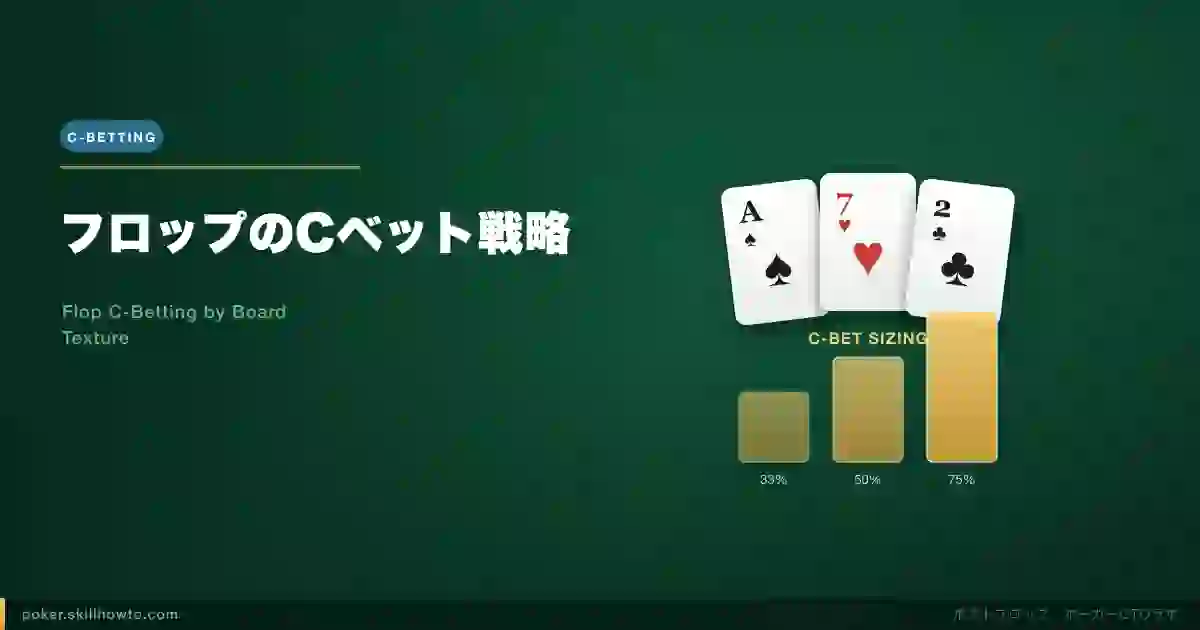
Dry boards (e.g., A♠7♦2♣)
A disconnected ace-high board favors the preflop raiser’s range (the caller has folded many Ax). Here, c-bet your whole range at a small size (¼–⅓ pot) and high frequency. Few hands need to fold out, so you keep initiative cheaply.
Wet boards (e.g., 9♥8♥7♣)
- •High c-bet frequency (~75%)
- •Small size (¼–⅓ pot)
- •Bet whole range
- •Range advantage: High
- •Check rarely
- •Lower c-bet frequency (~45%)
- •Large size (⅔–pot)
- •Bet strong hands & draws only
- •Range advantage: Reduced
- •Check weak holdings
Boards loaded with straight and flush draws are closer to the BB defender’s range, shrinking your edge. Default to a larger size (⅔–pot) at lower frequency: bet strong hands and draws, check back weak hands.
Boards to check
On boards that favor the caller (e.g., a low connected 6♠5♠4♥ after the BB calls), raise your checking frequency even as the raiser. Forcing c-bets here gets punished by raises and calls.
Sizing cheat sheet
| Board | Frequency | Size |
|---|---|---|
| Dry, high-card (Axx) | High | Small (¼–⅓) |
| Wet, connected/suited | Medium | Large (⅔–pot) |
| Caller-favored, low connected | Low | Check more |
Summary
C-betting isn’t “bet or not” — it’s “which board, what size, what frequency.” Dry → small and often; wet → big and selective; caller-favored → check. Master these three patterns and postflop snaps into focus.
Related reading
This article was prepared by the Poker GTO Lab editorial team for educational purposes, drawing on widely published solver outputs, training content, and preflop charts. The ranges and frequencies shown are representative tendencies; the true optimum depends on stack depth, opponents, and table rules. This site does not promote gambling.